
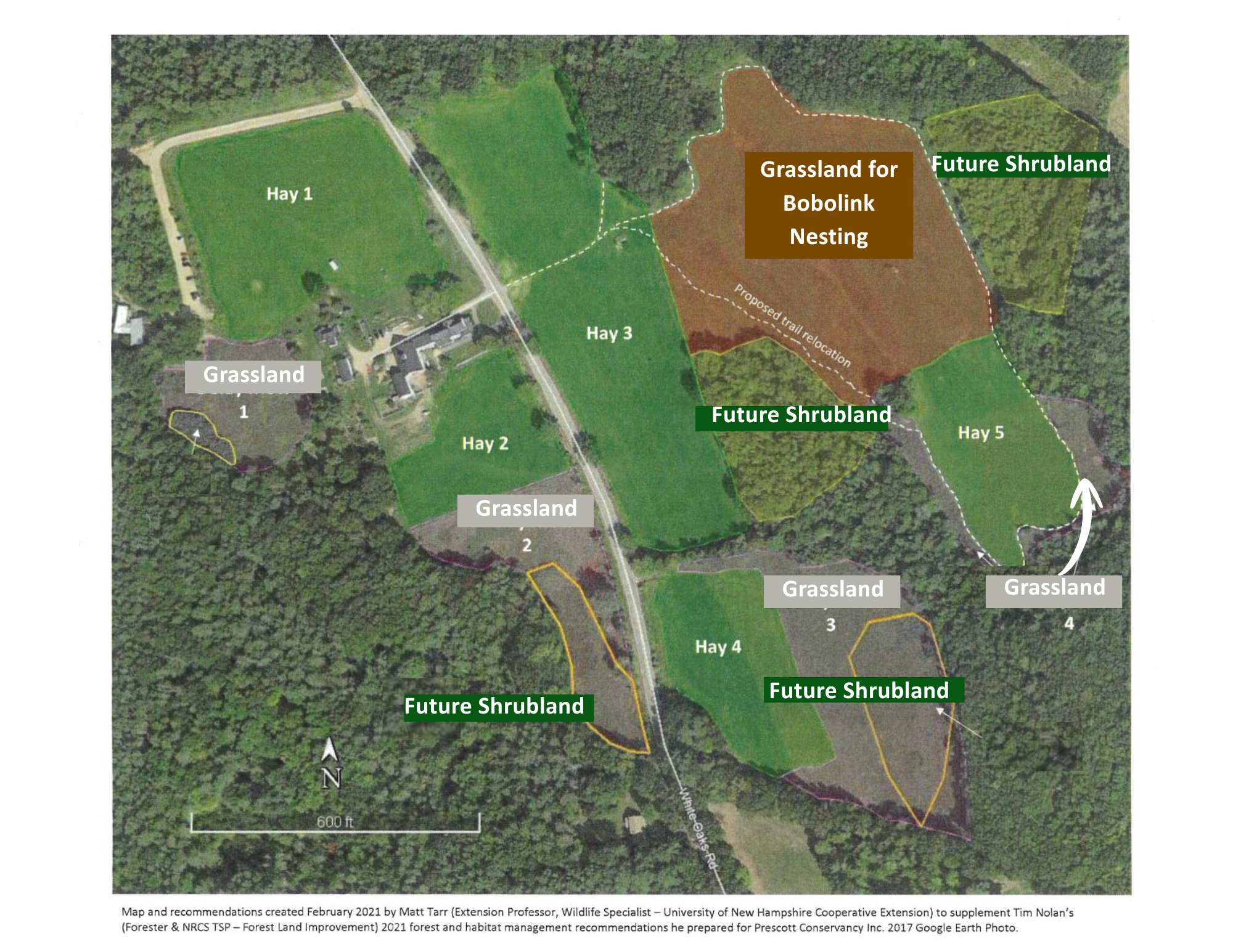
If you spend time exploring the trails, fields, and forests at Prescott Farm, you may notice some changes beginning in mid-January. That’s because we will begin a carefully planned forest management project on a portion of our 160-acre property.
Through this work, we aim to improve wildlife habitat, strengthen grassland and meadow ecosystems, and support the long-term health of our forest. Most importantly, these efforts help ensure Prescott Farm remains a vibrant place for both wildlife and learning.
Why Forest Management Is Important
Because forests change over time, healthy landscapes need thoughtful care. Just like gardens or fields, forests benefit from active management that encourages diversity and resilience.
For this reason, our work follows recommendations from Prescott Farm’s 2021 Forest Management Plan. The plan was developed with guidance from UNH Cooperative Extension Wildlife Specialist Matt Tarr and focuses on supporting wildlife while maintaining healthy, productive forests.
By actively managing select areas of our land, we can:
- Increase habitat diversity
- Support species that depend on young forest and meadow environments
- Improve long-term forest health
- Maintain access for future stewardship and education
What Forest Management Includes
As part of this project, we are partnering with Tim Nolin of Forest Land Improvement (Ossipee, NH), with logging conducted by L.E. Taylor & Sons, Inc., a family-owned company certified through the Master Logger Certification Program.
Specifically, we will create early successional habitat by clear-cutting two areas totaling approximately 4.5 acres next to existing fields. These areas currently contain poor-quality growth with limited long-term value. As a result, the work will expand meadow space and create productive transition zones between open fields and forest.
The result will be expanded meadow space paired with nearby shrubland, creating what ecologists call an “edge effect”—the transition zone between open field and mature forest that supports a wide variety of wildlife.
“These areas are being clear-cut to create functional blocks of early successional habitat right next to open, maintained fields,” explains Tim Nolin. “This edge effect is one of the most productive habitats for wildlife, and periodic maintenance ensures these benefits continue over time.”
Who Benefits From Forest Management?
Some wildlife depends on young forests for their ideal habitat. According to Good Forestry in the Granite State, more than 70% of New Hampshire’s vertebrate wildlife species rely on young forest habitat at some point in their lives. State guidance recommends maintaining 5–20% of the landscape in young forest—conditions that were historically common in the Lakes Region.
Overtime, the species expected to benefit from this work include:
- Bobolink
- Chestnut warbler
- Alder flycatcher
- American woodcock
- Wild turkey
- Red fox, bobcat, snowshoe hare
- White-tailed deer and meadow vole
We will maintain these openings on a 10–15 year cycle to preserve their long-term ecological value.
What Visitors Should Expect
During active operations, some trails may be temporarily rerouted. However, licensed professionals will complete all work using best management practices for soil protection, erosion control, and invasive species prevention.
To keep visitors informed, we will post updates both on-site and online as the project moves forward.
Forest Management to Create Living Classroom for the Community
Beyond its ecological benefits, this project will serve as a living classroom. The managed areas will be incorporated into upcoming public programs, including plant identification walks and birding classes scheduled for the upcoming season.
At the same time, this work also offers a practical example for local landowners interested in managing their own property. By showing sustainable forestry practices in action, we hope to help community members better understand how thoughtful management supports wildlife, forest health, and long-term resilience.
“As forests and fields in our area have increasingly been developed, pressures on native species have grown,” says Executive Director Jude Hamel. “We expect that community members will take an interest in the changes to our fields and forests and we hope they will get involved in some of the learning opportunities this project provides. After all, a big part of Prescott Farm’s work is teaching children and adults in our community about the interconnected plant and animal species native to this area and the choices we can all make in our lives to conserve the natural environment that sustains us all.”
Learn More
We invite visitors to explore the land, ask questions, and join us for upcoming programs that will highlight this work in action. Forest management can look dramatic in the short term, but its benefits—to wildlife, ecosystems, and future generations—are long-lasting.